
Meta Title: How Does Bitcoin Work? Blockchain, Mining & Transactions Explained
Meta Description: Learn how Bitcoin works in simple language. Discover Bitcoin transactions, blockchain, mining, blocks, confirmations, wallets, supply, fees, and security.
Focus Keyword: How Does Bitcoin Work
Secondary Keywords: Bitcoin explained, how Bitcoin transactions work, Bitcoin blockchain, Bitcoin mining, Bitcoin confirmations, Bitcoin supply, how Bitcoin works for beginners
Bitcoin is one of the most well-known digital assets in the world, but many people still wonder what actually happens when someone sends Bitcoin from one wallet to another.
Unlike traditional payment systems, Bitcoin does not depend on a central bank or a single company to maintain its transaction database. Instead, it uses a decentralized network, cryptography, a public blockchain, and a process called mining to record and secure transactions.
For beginners, Bitcoin can initially seem complicated because it combines several different technologies. However, the basic idea becomes much easier once the major components are understood separately.
This guide explains how Bitcoin works in simple language. We will look at Bitcoin transactions, wallets, addresses, private keys, blocks, miners, confirmations, transaction fees, blockchain security, Bitcoin’s limited supply, and the role of the decentralized network.
Important: This article is for educational purposes only. Bitcoin is a volatile digital asset, and nothing in this guide should be considered financial or investment advice.
What Is Bitcoin?
Bitcoin is a decentralized digital asset and payment system introduced in 2009 under the name Satoshi Nakamoto.
Bitcoin was designed to allow people to transfer value electronically without requiring a traditional financial intermediary to authorize every transaction.
Traditional electronic payments generally involve organizations such as:
- Banks
- Payment processors
- Card networks
- Financial institutions
Bitcoin works differently.
Transactions are broadcast to a decentralized network of computers. The network follows a set of rules for validating transactions and maintaining the blockchain.
Bitcoin uses cryptography to authorize transactions and Proof of Work mining to help secure the network and add new blocks to the blockchain.
The Bitcoin network is open to participation, although operating a full node, mining, or using Bitcoin are different activities with different technical requirements.
How Does Bitcoin Work in Simple Terms?
At a very basic level, Bitcoin works through five major components:
- Bitcoin wallets manage the information needed to send and receive BTC.
- Transactions describe transfers of Bitcoin between addresses.
- Nodes independently verify transactions and enforce the network’s rules.
- Miners compete to add valid blocks to the blockchain through Proof of Work.
- The blockchain records confirmed transactions in chronological order.
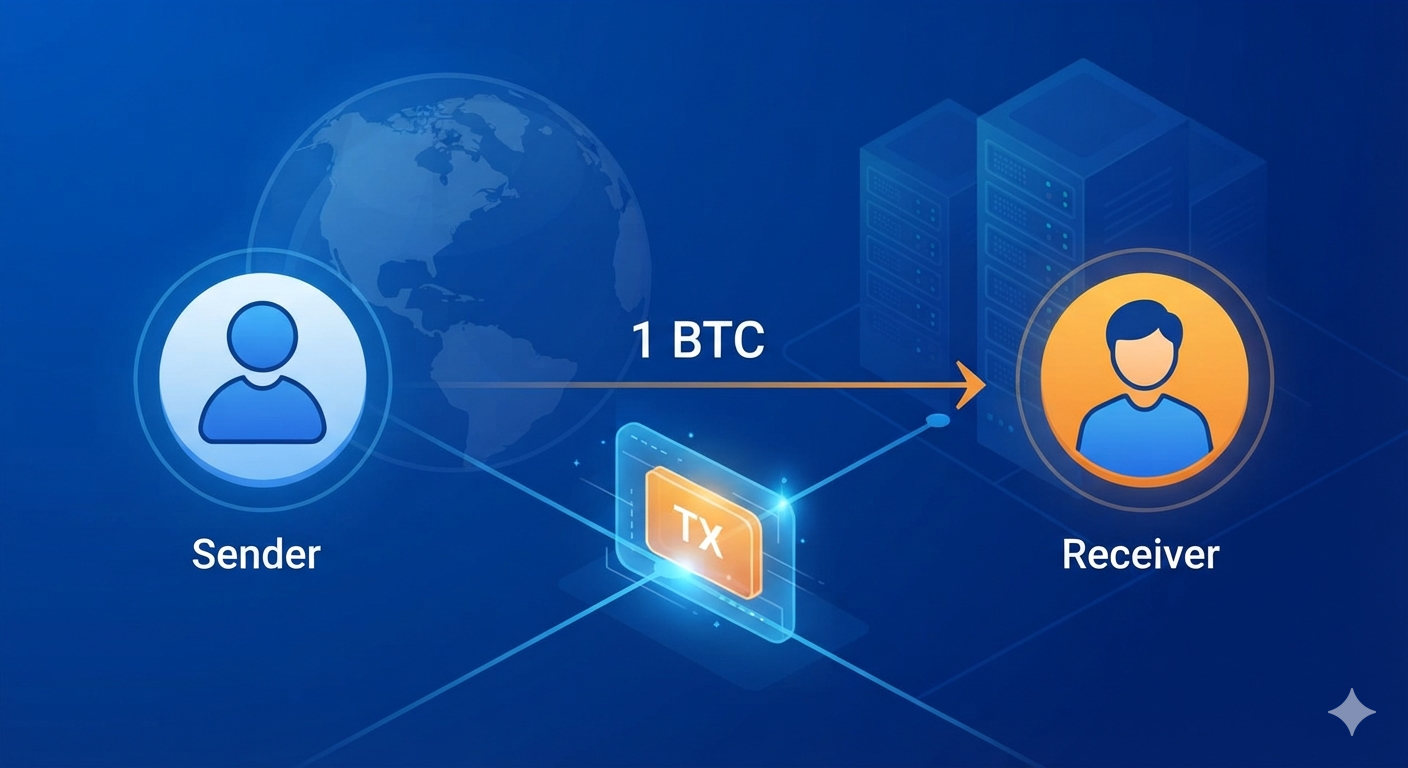
Imagine that Alice wants to send Bitcoin to Bob.
Alice creates a transaction using her wallet.
Her wallet uses cryptographic information to authorize the transaction.
The transaction is broadcast to the Bitcoin network.
Nodes check whether the transaction follows Bitcoin’s rules.
Valid transactions can enter the pool of unconfirmed transactions.
Miners select transactions and attempt to create a new block.
A miner that successfully produces a valid block broadcasts it to the network.
Other nodes verify the block.
If accepted, the block becomes part of the blockchain.
Bob’s wallet can then see the transaction and, as additional blocks are added, the transaction receives more confirmations.
That is the basic Bitcoin transaction process.
What Is the Bitcoin Blockchain?
The Bitcoin blockchain is a public, distributed ledger containing the history of Bitcoin transactions.
Think of it as a continuously growing record of transactions maintained by a decentralized network.
Transactions are organized into blocks.
Each block is connected to the previous block through cryptographic information, creating a chain.
Hence the term:
Blockchain = Block + Chain
The blockchain provides a common historical record that Bitcoin participants can independently verify.
There is not one single computer somewhere holding the only copy of the Bitcoin blockchain.
Instead, many computers called nodes maintain and verify copies of the blockchain according to Bitcoin’s protocol rules.
What Is a Bitcoin Block?
A block is a collection of Bitcoin transactions and other information used by the Bitcoin protocol.
A typical Bitcoin block contains information such as:
- A reference to the previous block
- A timestamp
- A transaction collection
- A Merkle root
- Mining-related information
- Proof-of-Work data
Blocks are produced sequentially.
Each block references the previous block, creating a chronological chain.
When a new block is accepted by the network, it becomes part of Bitcoin’s blockchain history.
How Are Bitcoin Transactions Created?
Suppose you want to send Bitcoin to another person.
You normally use a wallet application.
The wallet requires information such as:
- The amount of BTC
- The recipient’s Bitcoin address
- The appropriate transaction fee
The wallet then creates a transaction.
A Bitcoin transaction does not simply say:
“Send $100 to Bob.”
Instead, it contains technical information that tells the Bitcoin network how the transaction spends previous Bitcoin outputs and creates new outputs.
This is important because Bitcoin uses a transaction model known as the UTXO model.
What Is a Bitcoin UTXO?
UTXO stands for Unspent Transaction Output.
It represents a Bitcoin transaction output that has not yet been spent.
A simple analogy is physical cash.
Suppose you have a $50 banknote and want to pay someone $20.
You cannot physically cut the banknote into two pieces. Instead, you could give the $50 note to a cashier and receive $30 in change.
Bitcoin works differently technically, but the concept of inputs and outputs provides a useful analogy.
A Bitcoin transaction can consume previous outputs and create new outputs.
One output may go to the recipient, while another may return remaining value to a change address controlled by the sender.
What Is a Bitcoin Address?
A Bitcoin address is a destination identifier used to receive Bitcoin.
It can be generated from cryptographic keys associated with a wallet.
Different Bitcoin address formats exist, including:
- Legacy addresses
- SegWit addresses
- Native SegWit addresses
- Taproot addresses
The exact format depends on the wallet and transaction type.
When sending Bitcoin, it is extremely important to verify the destination address carefully.
A Bitcoin transaction sent to an incorrect address may not be recoverable.
What Is a Bitcoin Wallet?
A Bitcoin wallet is software or hardware that allows users to manage the cryptographic keys needed to interact with Bitcoin.
It is important to understand that the wallet does not physically contain Bitcoin.
Bitcoin ownership is represented by control over the relevant cryptographic keys and the ability to authorize transactions.
Wallets can include:
Software Wallets
These run on:
- Smartphones
- Computers
- Web browsers
They are convenient but can be exposed to online threats.
Hardware Wallets
Hardware wallets are dedicated devices designed to keep private keys more isolated from internet-connected environments.
They can be useful for people who want stronger protection for long-term holdings.
Custodial Wallets
When Bitcoin is held on a centralized exchange, the exchange may control the private keys rather than the user.
This creates a different risk model from self-custody.
What Is a Bitcoin Private Key?
A private key is sensitive cryptographic information that can authorize transactions involving Bitcoin controlled by the corresponding key.
This is why private-key security is essential.
If someone obtains your private key or wallet recovery information, they may be able to move your Bitcoin.
You should never share private keys or recovery phrases with strangers.
A legitimate service should not need your wallet recovery phrase simply to “verify” your account.
What Is a Bitcoin Public Key?
A public key is cryptographic information associated with a private key.
Bitcoin uses public-key cryptography to allow users to prove authorization without publicly revealing their private keys.
In simplified terms:
Private key → kept secret
Public information → can be shared according to the wallet/address system
Modern Bitcoin addresses are not simply the same thing as public keys, but addresses are derived from underlying cryptographic information.
What Happens When You Send Bitcoin?
Let’s walk through a Bitcoin transaction from beginning to end.
Step 1: The Sender Creates a Transaction
The sender enters the recipient’s address and the amount of Bitcoin they want to send.
The wallet selects suitable UTXOs to use as inputs.
Step 2: The Transaction Is Signed
The wallet uses the sender’s private key to create a cryptographic signature.
This signature proves that the person controlling the relevant Bitcoin can authorize the transaction.
Step 3: The Transaction Is Broadcast
The wallet sends the transaction to one or more Bitcoin nodes.
The transaction spreads through the peer-to-peer network.
Step 4: Nodes Verify It
Nodes check whether the transaction follows Bitcoin’s consensus rules.
They can check things such as:
- Whether the inputs are valid
- Whether the inputs have already been spent
- Whether the signatures are valid
- Whether the transaction follows protocol rules
Step 5: The Transaction Waits for Confirmation
A valid transaction may enter a node’s mempool while waiting to be included in a block.
Step 6: A Miner Includes the Transaction
Miners select transactions and construct candidate blocks.
Step 7: Proof of Work Is Completed
Miners perform computational work to find a valid block according to Bitcoin’s Proof-of-Work rules.
Step 8: The Block Is Broadcast
The successful miner broadcasts the block.
Step 9: Nodes Verify the Block
Other nodes independently verify the block and its transactions.
Step 10: The Transaction Gets Confirmed
If the block becomes part of the accepted blockchain, the transaction has one confirmation.
Additional blocks added afterward increase the confirmation count.
What Is Bitcoin Mining?
Bitcoin mining is the process used by the Bitcoin network’s Proof-of-Work consensus mechanism to add new blocks and help secure the blockchain.
Miners use specialized hardware to perform enormous numbers of calculations.
Their objective is to find a valid value that satisfies the current network difficulty requirement.
This process is intentionally computationally expensive.
When a miner successfully creates a valid block, the miner can receive rewards according to Bitcoin’s protocol, including the block subsidy and transaction fees.
Mining therefore has two major roles:
- Helping process and order transactions
- Securing the blockchain through Proof of Work
Why Does Bitcoin Need Miners?
Bitcoin needs a mechanism for determining which valid transactions become part of the blockchain and in what order.
In a traditional banking system, a central institution maintains the official transaction database.
Bitcoin does not have a central authority performing that role.
Proof of Work provides a decentralized mechanism for selecting which participant gets to propose the next block.
Mining also makes certain types of attacks more expensive because altering historical blocks would require significant computational work.
What Is Proof of Work?
Proof of Work is a consensus mechanism based on computational effort.
Bitcoin miners repeatedly modify data in a candidate block and calculate cryptographic hashes.
They are searching for a hash that satisfies the network’s difficulty target.
There is no shortcut that reliably lets a miner know which input will produce the required result.
Therefore, miners perform large numbers of attempts.
Once a valid result is found, other network participants can verify it relatively quickly.
This asymmetry is important:
Finding the solution is expensive; verifying the solution is comparatively easy.
What Is a Bitcoin Hash?
A hash is the output of a cryptographic hash function.
Bitcoin uses the SHA-256 hashing algorithm in its Proof-of-Work system.
A hash can be represented as a string of numbers and letters.
A tiny change in the input produces a significantly different hash.
For example, changing one character in a message can produce a completely different hash output.
Bitcoin uses hashing in several parts of its system, including:
- Proof of Work
- Block identification
- Transaction structures
- Merkle trees
What Is Bitcoin Mining Difficulty?
Bitcoin’s mining difficulty controls how difficult it is to find a valid Proof-of-Work solution.
The Bitcoin protocol adjusts difficulty periodically so that blocks are produced at an approximately predictable average rate over time.
The target is approximately one block every 10 minutes on average.
This does not mean that a block is guaranteed to appear exactly every 10 minutes.
Blocks can sometimes arrive closer together or farther apart.
The long-term protocol target helps maintain a predictable issuance and transaction-processing rhythm.
What Is a Bitcoin Block Reward?
Bitcoin miners can receive rewards for successfully mining blocks.
The reward has historically consisted of two major components:
- Block subsidy
- Transaction fees
The block subsidy introduces new bitcoins according to Bitcoin’s issuance schedule.
The subsidy decreases through programmed halving events.
Transaction fees are paid by users whose transactions are included in blocks.
What Is Bitcoin Halving?
Bitcoin’s block subsidy is periodically reduced through an event commonly called the Bitcoin halving.
Historically, the subsidy has been reduced by approximately half after every 210,000 blocks.
The purpose is to follow Bitcoin’s programmed issuance schedule.
The approximate subsidy history includes:
- 2009: 50 BTC
- 2012: 25 BTC
- 2016: 12.5 BTC
- 2020: 6.25 BTC
- 2024: 3.125 BTC
Future halvings will continue reducing the subsidy until the issuance approaches Bitcoin’s maximum supply limit.
What Is the Maximum Bitcoin Supply?
Bitcoin’s protocol is designed around a maximum supply of approximately 21 million BTC.
This is one of the characteristics that distinguishes Bitcoin from currencies whose supply can be changed through monetary policy.
Bitcoin’s supply is introduced through the protocol’s issuance schedule.
As the block subsidy decreases, fewer new bitcoins are created through mining.
The final issuance dynamics are expected to extend toward the year 2140, although exact future details depend on the network’s continued operation and protocol rules.
Why Is Bitcoin Limited to 21 Million?
The limited supply is part of Bitcoin’s protocol design.
The supply schedule creates predictable issuance rather than allowing an administrator to arbitrarily create unlimited bitcoins under the existing rules.
This scarcity is one reason Bitcoin is sometimes described as a scarce digital asset.
However, scarcity alone does not guarantee a particular market value.
An asset’s price is influenced by supply, demand, liquidity, market conditions, adoption, and many other factors.
What Are Bitcoin Confirmations?
A Bitcoin confirmation occurs when a transaction is included in a block that becomes part of the accepted blockchain.
Suppose your transaction is included in the latest block.
It has:
1 confirmation
When another block is added after it:
2 confirmations
Then:
3 confirmations
And so on.
More confirmations generally mean that more Proof of Work has been built on top of the block containing the transaction.
This can reduce the practical risk of certain blockchain reorganizations.
How Many Bitcoin Confirmations Are Needed?
There is no universal number that applies to every situation.
Different exchanges, businesses, and services can have different policies.
Some low-value transactions may be accepted after fewer confirmations, while higher-value transfers may require more.
The appropriate number depends on:
- Transaction value
- Risk tolerance
- Business policy
- Network conditions
- Security requirements
Users should follow the specific requirements of the service receiving the Bitcoin.
What Is the Bitcoin Mempool?
The Bitcoin mempool is a collection of valid, unconfirmed transactions waiting to be included in blocks.
When you send Bitcoin, your transaction may enter the mempool before a miner includes it in a block.
There is not necessarily one identical global mempool.
Different nodes can have slightly different sets of unconfirmed transactions.
The mempool can become busier when transaction demand increases.
Why Do Bitcoin Transaction Fees Change?
Bitcoin transaction fees are influenced largely by demand for limited block space.
Each Bitcoin block has limited capacity.
When many users want their transactions included quickly, users may compete by offering higher fees.
During periods of low demand, lower fees may be sufficient for timely confirmation.
Therefore, transaction fees can change significantly over time.
A wallet may estimate an appropriate fee based on current network conditions.
What Is a Bitcoin Fee Rate?
Bitcoin fees are often discussed using a rate such as sat/vB, meaning satoshis per virtual byte.
The transaction’s size affects the total fee.
A transaction with more inputs can require more block space than a simpler transaction.
This means two transactions sending similar amounts of Bitcoin can have very different fees.
The fee is related to transaction size and fee rate, not simply the amount of Bitcoin being sent.
Why Can Bitcoin Transactions Take Time?
Bitcoin transactions can take time because transactions need to be broadcast, verified, selected by miners, included in a block, and confirmed.
The time can depend on:
- Current network activity
- Fee rate
- Mempool conditions
- Block timing
- Service policies
If a transaction uses a low fee during a period of high demand, it may wait longer before being included in a block.
Is Bitcoin Anonymous?
Bitcoin is generally better described as pseudonymous rather than fully anonymous.
Bitcoin’s blockchain is public.
Transaction information can be viewed and analyzed.
Addresses do not automatically contain a person’s real-world name, but blockchain analysis and information from exchanges or other sources can sometimes connect addresses with identities.
Therefore, users should not assume that Bitcoin transactions are completely private.
Is the Bitcoin Blockchain Secure?
Bitcoin’s security comes from several interacting components:
- Cryptography
- Decentralized nodes
- Proof of Work
- Economic incentives
- Network consensus rules
- Distributed verification
However, “secure” does not mean that every Bitcoin-related activity is safe.
Users can still lose funds through:
- Phishing
- Malware
- Stolen private keys
- Fake wallets
- Exchange failures
- Incorrect addresses
- Social engineering
- Fraud
The Bitcoin protocol and the security of an individual user’s wallet are separate issues.
Bitcoin Network vs. Bitcoin Exchange
It is important to distinguish between Bitcoin itself and cryptocurrency exchanges.
The Bitcoin network is a decentralized protocol.
An exchange is a separate business or service that allows users to trade Bitcoin and potentially other assets.
If an exchange experiences:
- A security breach
- Withdrawal restrictions
- Operational problems
- Insolvency
- Regulatory issues
that does not necessarily mean the Bitcoin blockchain itself has stopped working.
The two systems should not be confused.
Bitcoin Self-Custody vs. Exchange Custody
With self-custody, the user controls the private keys.
This provides direct control but also places responsibility on the user.
If the user loses their recovery information, there may be no central organization capable of restoring access.
With exchange custody, the exchange controls the relevant keys on behalf of users.
This can be more convenient but introduces counterparty and platform risks.
Neither approach should be treated as completely risk-free.
The important thing is understanding who controls the keys and what risks that creates.
What Happens If You Send Bitcoin to the Wrong Address?
Bitcoin transactions are generally designed to be irreversible after confirmation.
If you send Bitcoin to the wrong address, recovery may be impossible unless the recipient controls the address and voluntarily returns the funds.
This is why users should carefully verify:
- Address
- Amount
- Network
- Destination
- Transaction fee
Copying and pasting an address can reduce typing errors, but users should still verify the destination.
Can Bitcoin Be Hacked?
It is important to distinguish between hacking Bitcoin’s underlying network and stealing Bitcoin through individual security weaknesses.
Bitcoin’s blockchain is protected by cryptography, Proof of Work, and decentralized verification.
However, attackers can target:
- Exchanges
- Wallet software
- Computers
- Mobile phones
- Cloud accounts
- Email accounts
- Users themselves
For example, a phishing attack could trick someone into revealing wallet credentials.
In such a case, the attacker may steal Bitcoin without breaking Bitcoin’s cryptographic system.
Bitcoin Nodes Explained
A Bitcoin node is a computer running Bitcoin software that participates in the network.
Full nodes independently verify transactions and blocks according to Bitcoin’s consensus rules.
Nodes help enforce rules such as:
- Valid transaction structure
- Valid signatures
- Valid block structure
- No unauthorized creation of Bitcoin
- Valid Proof of Work
- Proper transaction spending
Running a full node is different from mining.
A node verifies the network’s rules, while a miner performs Proof of Work and proposes blocks.
A participant can run a node without mining.
Why Are Bitcoin Nodes Important?
Nodes provide independent verification.
Instead of trusting a single organization to tell users which transactions are valid, Bitcoin participants can verify the blockchain according to the protocol.
This is an important part of Bitcoin’s decentralized design.
The more independent participants verify the rules, the less dependent the system is on a single authority.
Bitcoin’s Decentralized Network
Bitcoin uses a peer-to-peer network.
Nodes communicate directly with other nodes to share:
- Transactions
- Blocks
- Network information
There is no central Bitcoin server that controls the entire network.
This decentralized architecture is one of Bitcoin’s defining characteristics.
However, decentralization is not a simple yes-or-no property. Different aspects of the ecosystem, including mining, node distribution, development, exchanges, and custody, can have different levels of concentration.
What Makes Bitcoin Different From a Bank?
A traditional bank maintains customer accounts through centralized systems.
The bank records balances and processes transactions.
Bitcoin uses a decentralized blockchain-based system.
With Bitcoin:
- Transactions are broadcast to a peer-to-peer network.
- Nodes verify transactions.
- Miners use Proof of Work to produce blocks.
- The blockchain records transaction history.
- Users can control their own keys through self-custody.
This creates a different model of financial ownership and transaction processing.
Bitcoin’s Monetary Supply
Bitcoin has a predictable issuance schedule.
New BTC enters circulation primarily through the block subsidy paid to miners.
The subsidy decreases over time through halving events.
This creates a declining rate of new issuance.
Because the maximum supply is approximately 21 million BTC, Bitcoin is often discussed in terms of digital scarcity.
However, users should distinguish between limited supply and guaranteed value.
A limited supply does not guarantee that the market price will rise.
Can Bitcoin Be Divided?
Yes.
One Bitcoin can be divided into:
100,000,000 satoshis
A satoshi is the smallest standard unit of Bitcoin currently used in ordinary Bitcoin accounting.
This divisibility allows users to transact with very small amounts of BTC.
You do not need to purchase one whole Bitcoin to use the Bitcoin network.
Why Does Bitcoin Have Value?
Bitcoin’s market value is determined by market participants.
Factors that can influence demand include:
- Perceptions of scarcity
- Adoption
- Network effects
- Use cases
- Market liquidity
- Investor sentiment
- Macroeconomic conditions
- Regulatory developments
- Technological developments
There is no single factor that determines Bitcoin’s price.
Bitcoin’s price can change significantly, sometimes within short periods.
Bitcoin and Lightning Network
The Bitcoin blockchain is designed with specific capacity and settlement characteristics.
The Lightning Network is a separate protocol layer designed to enable faster Bitcoin payments through payment channels.
Instead of recording every transaction directly on the Bitcoin blockchain, Lightning can process certain transactions off-chain and use the Bitcoin blockchain for settlement.
Potential advantages include:
- Faster payments
- Potentially lower transaction costs for suitable use cases
- Additional payment flexibility
However, Lightning also has its own technical concepts and risks.
It should be understood as an additional layer rather than a replacement for Bitcoin’s base blockchain.
Common Bitcoin Myths
Myth 1: Bitcoin Is Completely Anonymous
Bitcoin transactions are publicly recorded, so Bitcoin is not automatically anonymous.
Myth 2: Bitcoin Exists Inside Your Wallet
The blockchain records Bitcoin ownership. The wallet manages keys used to control associated funds.
Myth 3: You Need One Whole Bitcoin
Bitcoin is divisible into smaller units.
Myth 4: Bitcoin Transactions Are Always Instant
Transactions can require time for confirmation.
Myth 5: Bitcoin Has No Fees
Bitcoin transactions can involve network fees.
Myth 6: Bitcoin Is Controlled by One Company
Bitcoin operates through a decentralized network rather than one central company.
Myth 7: Bitcoin Price Can Only Go Up
Bitcoin is volatile, and its price can decline substantially.
How Beginners Can Learn Bitcoin Safely
If you are new to Bitcoin, start with education rather than rushing into transactions.
Learn these concepts first:
- Bitcoin blockchain
- Wallets
- Private keys
- Addresses
- UTXOs
- Transactions
- Mining
- Proof of Work
- Confirmations
- Transaction fees
- Bitcoin supply
- Security
After understanding these basics, you can explore more advanced subjects such as:
- Lightning Network
- Multisignature wallets
- Bitcoin script
- Taproot
- Coin selection
- Fee management
- Hardware wallets
- Running a full node
Bitcoin Security Checklist for Beginners
Before sending or storing Bitcoin, consider the following checklist:
1. Protect Your Private Keys
Never share your private key or seed phrase.
2. Use Trusted Wallet Software
Download wallet software only from legitimate sources.
3. Verify Addresses
Check the recipient address before confirming a transaction.
4. Check Fees
Understand the transaction fee before sending.
5. Check the Network
Make sure you are using the correct Bitcoin network and service.
6. Beware of Fake Support
Do not give wallet credentials to people claiming to be customer support.
7. Avoid Guaranteed Profit Claims
No legitimate person can guarantee a particular Bitcoin return.
8. Consider Hardware Security
For larger long-term holdings, research appropriate self-custody and hardware-wallet practices.
9. Keep Backups Secure
Store wallet recovery information safely and separately from your everyday devices.
10. Test With a Small Transaction
For unfamiliar destinations, consider sending a small amount first when appropriate.
Frequently Asked Questions About How Bitcoin Works
How does Bitcoin work without a bank?
Bitcoin uses a decentralized network of nodes and miners. Nodes verify transactions according to protocol rules, while miners use Proof of Work to add blocks to the blockchain.
How long does a Bitcoin transaction take?
The time varies. A transaction may appear quickly in the network but can take longer to receive block confirmations.
What happens after a Bitcoin transaction is confirmed?
The transaction becomes part of the blockchain history. Additional blocks can then provide additional confirmations.
Why does Bitcoin have a 21 million supply limit?
The approximately 21 million maximum supply is built into Bitcoin’s protocol and issuance schedule.
What do Bitcoin miners do?
Miners use specialized computing equipment to perform Proof of Work, helping produce blocks and secure the network.
Do miners control Bitcoin?
Miners participate in transaction processing and block production, but they do not have unilateral authority to change Bitcoin’s consensus rules.
Can Bitcoin transactions be reversed?
Generally, confirmed Bitcoin transactions cannot simply be reversed like a conventional card payment. Recovery depends on the recipient and circumstances.
What is the smallest unit of Bitcoin?
The smallest standard unit is a satoshi, equal to 0.00000001 BTC.
Is Bitcoin a blockchain?
Bitcoin refers both to the digital asset and the broader protocol/network. The Bitcoin blockchain is the distributed ledger that records Bitcoin transactions.
Can I use Bitcoin without buying one whole coin?
Yes. Bitcoin is divisible into smaller units, so users can transact with fractions of one BTC.
Conclusion: How Does Bitcoin Work?
So, how does Bitcoin work?
Bitcoin combines several technologies and economic incentives to create a decentralized digital payment and asset system.
A user creates a transaction with a wallet. The transaction is cryptographically authorized and broadcast to the Bitcoin network. Nodes verify that it follows the protocol’s rules. The transaction can then enter the mempool while waiting for inclusion in a block.
Miners collect transactions into candidate blocks and compete through Proof of Work. When a valid block is produced, it is broadcast to the network. Other nodes verify the block and, if it follows the consensus rules, accept it as part of the blockchain.
Once a transaction is included in a block, it receives its first confirmation. Additional blocks provide additional confirmations.
Bitcoin’s monetary system is governed by protocol rules, including a declining block subsidy and an approximately 21 million maximum supply.
For beginners, the most important concepts to remember are:
Wallets control keys.
Transactions transfer Bitcoin according to protocol rules.
Nodes verify the rules.
Miners use Proof of Work to produce blocks.
Blocks form the blockchain.
Confirmations provide additional settlement history.
Bitcoin’s supply follows a programmed issuance schedule.
Understanding these fundamentals provides a strong foundation for learning more about Bitcoin, blockchain technology, digital assets, and decentralized networks.
SEO FAQ Schema Questions
What is Bitcoin in simple words?
Bitcoin is a decentralized digital asset and payment network that uses cryptography, a peer-to-peer network, and a blockchain to process and record transactions.
How does Bitcoin mining work?
Bitcoin mining uses Proof of Work. Miners perform large numbers of calculations to find a valid block solution and compete to add the next block to the blockchain.
How are Bitcoin transactions confirmed?
A transaction receives a confirmation when it is included in a block accepted by the Bitcoin network. Additional blocks provide additional confirmations.
How many Bitcoins will ever exist?
Bitcoin’s protocol is designed around a maximum supply of approximately 21 million BTC.
What is the Bitcoin blockchain?
The Bitcoin blockchain is a distributed public ledger containing the history of Bitcoin transactions and blocks.
What is a Bitcoin wallet?
A Bitcoin wallet is software or hardware used to manage the cryptographic keys needed to receive and authorize Bitcoin transactions.