Meta Title: What Is Blockchain Technology? A Simple Guide for Beginners
Meta Description: Learn what blockchain technology is, how distributed ledgers, blocks, consensus, transparency, and security work, and discover real-world blockchain applications.
Focus Keyword: what is blockchain technology
Secondary Keywords: blockchain explained, how blockchain works, distributed ledger technology, blockchain security, blockchain applications, blockchain for beginners, blockchain technology explained
Suggested URL Slug: what-is-blockchain-technology
Introduction
Blockchain technology is one of the most discussed technologies in the world of cryptocurrency, finance, business, and digital innovation. Bitcoin introduced blockchain to millions of people, but the technology itself has uses that go far beyond digital currencies.
For beginners, blockchain can sound complicated because it involves terms such as distributed ledgers, blocks, nodes, consensus mechanisms, cryptography, hashes, and decentralized networks. However, the basic idea is easier to understand than it first appears.
At its simplest, a blockchain is a type of digital record-keeping system. Instead of storing information in one central database controlled by a single organization, a blockchain can distribute copies of its records across a network of computers. Transactions or other pieces of information are grouped into blocks, and these blocks are connected together in a chronological chain.
This structure can make blockchain records difficult to alter without detection. Depending on the blockchain, participants can also verify information without relying entirely on one central authority.
In this guide, we will explain blockchain technology in simple language. You will learn what a blockchain is, how blocks work, what distributed ledgers mean, how consensus mechanisms help networks agree, why transparency matters, how blockchain security works, and where blockchain is being used in the real world.
What Is Blockchain Technology?
Blockchain technology is a digital system for recording and sharing information across a network of computers.
The word blockchain comes from two basic concepts:
- Block: A group of recorded information.
- Chain: A connection between multiple blocks.
When information is recorded on a blockchain, it is organized into blocks. These blocks are linked together using cryptographic techniques, creating a chronological chain of records.
Unlike a traditional database, where information may be controlled by a central organization, many blockchains are distributed across multiple independent computers called nodes.
For example, imagine a traditional banking database.
When you send money through a bank, the bank’s systems keep the official record of your account balance and transaction history. You generally trust the bank to maintain accurate records.
A public blockchain works differently. Multiple computers on the network can maintain copies of the blockchain and independently verify transactions according to the network’s rules.
This is one of the main ideas behind blockchain technology:
Instead of relying entirely on one central record keeper, a network can use shared rules and verification mechanisms to maintain a common digital record.
Blockchain Explained With a Simple Example
Imagine a notebook shared by 1,000 people.
Every participant has a copy of the notebook. Whenever a new transaction is proposed, the network checks whether it follows the agreed rules.
Once a group of valid transactions is accepted, they are written into a new page.
That page is connected to the previous page using a special digital fingerprint.
If someone secretly changes an old page, its fingerprint changes. Other participants can detect that the modified page no longer matches the expected chain.
A blockchain is much more sophisticated than a shared notebook, but this example demonstrates several important concepts:
- Shared records
- Multiple copies
- Verification
- Blocks
- Cryptographic links
- Consensus
- Tamper detection
What Is a Distributed Ledger?
One of the most important blockchain concepts is the distributed ledger.
A ledger is simply a record of transactions or other information.
For centuries, businesses and financial institutions have used ledgers to record who owns what, who paid whom, and what transactions occurred.
A traditional ledger might be controlled by one organization.
A distributed ledger can instead be maintained across multiple computers or participants in a network.
How a Distributed Ledger Works
Suppose a blockchain network contains thousands of participating computers.
Instead of keeping only one central copy of the ledger, many network participants maintain their own copies or relevant portions of the blockchain’s data.
When a transaction is submitted:
- The transaction is broadcast to the network.
- Network participants check the transaction.
- Valid transactions are selected for inclusion in a block.
- The network reaches agreement according to its consensus mechanism.
- The block is added to the blockchain.
- Network participants update their records.
This distribution can reduce dependence on a single database or central server.
However, distributed does not automatically mean completely decentralized. Different blockchain networks have different levels of decentralization.
Blockchain vs Traditional Database
A blockchain and a traditional database can both store information, but they are designed for different purposes.
| Feature | Traditional Database | Blockchain |
|---|---|---|
| Control | Often centralized | Can be distributed |
| Data structure | Tables/records | Blocks and transactions |
| Modification | Authorized users can edit records | Changes follow network rules |
| Verification | Usually controlled by an organization | Can involve network participants |
| Transparency | Depends on system | Public blockchains can be highly transparent |
| Performance | Often very fast | Can involve network limitations |
| Governance | Usually centralized | Rules vary by blockchain |
| Main use | General data storage | Shared, verifiable records |
This does not mean blockchain is always better than a traditional database.
For many applications, a conventional database is faster, simpler, cheaper, and more practical.
Blockchain becomes particularly interesting when multiple parties need to share records but may not want to rely entirely on a single organization.
What Is a Block?
A block is a collection of information recorded on a blockchain.
On a cryptocurrency network, a block can contain multiple transactions.
A block generally contains information such as:
- Transaction data
- A reference to the previous block
- A timestamp or related timing information
- A cryptographic hash
- Network-specific metadata
- Other information required by the blockchain protocol
Different blockchains use different block structures, so there is no universal format that applies to every blockchain.
The important concept is that blocks are connected to previous blocks, forming a chain.
What Is a Blockchain Hash?
A hash is a type of digital fingerprint generated from data.
Cryptographic hash functions take input data and produce an output of a fixed format.
If the input changes, even slightly, the resulting hash normally changes significantly.
For example, imagine that a blockchain block has a particular hash.
If someone changes one transaction inside that block, the block’s hash will change.
Because later blocks reference earlier blocks, altering historical information can create inconsistencies that the network can detect.
This is one reason blockchain records are described as tamper-evident.
It is important to understand the difference between tamper-evident and impossible to change.
Blockchain does not mean that information can never be changed under any circumstances. Different networks have different rules, and some blockchain data can be modified through protocol-level mechanisms, upgrades, governance processes, or other methods.
The important point is that unauthorized changes can be difficult to make without detection or network agreement.
How Blocks Are Connected
Suppose a blockchain contains three blocks:
Block 1 → Block 2 → Block 3
Block 2 contains a reference to Block 1.
Block 3 contains a reference to Block 2.
This creates a historical relationship between the blocks.
If someone attempts to change information in Block 1, its cryptographic fingerprint changes. That can cause the references in later blocks to no longer match.
In systems such as Bitcoin, changing historical blocks would also involve overcoming the blockchain’s consensus and security mechanisms.
This combination of cryptographic linking and network validation helps protect the integrity of the blockchain.
What Is a Blockchain Node?
A node is a computer or device that participates in a blockchain network.
Nodes can perform different functions depending on the blockchain.
For example, a node may:
- Receive transactions
- Verify transactions
- Store blockchain data
- Relay information to other nodes
- Verify blocks
- Enforce network rules
Some networks have different categories of nodes with different responsibilities.
In a decentralized public blockchain, nodes are important because they allow participants to independently verify information instead of trusting one central server.
How Does Blockchain Work?
Although each blockchain has its own design, a simplified blockchain transaction process looks like this:
Step 1: A transaction is created
A user creates a transaction.
For example:
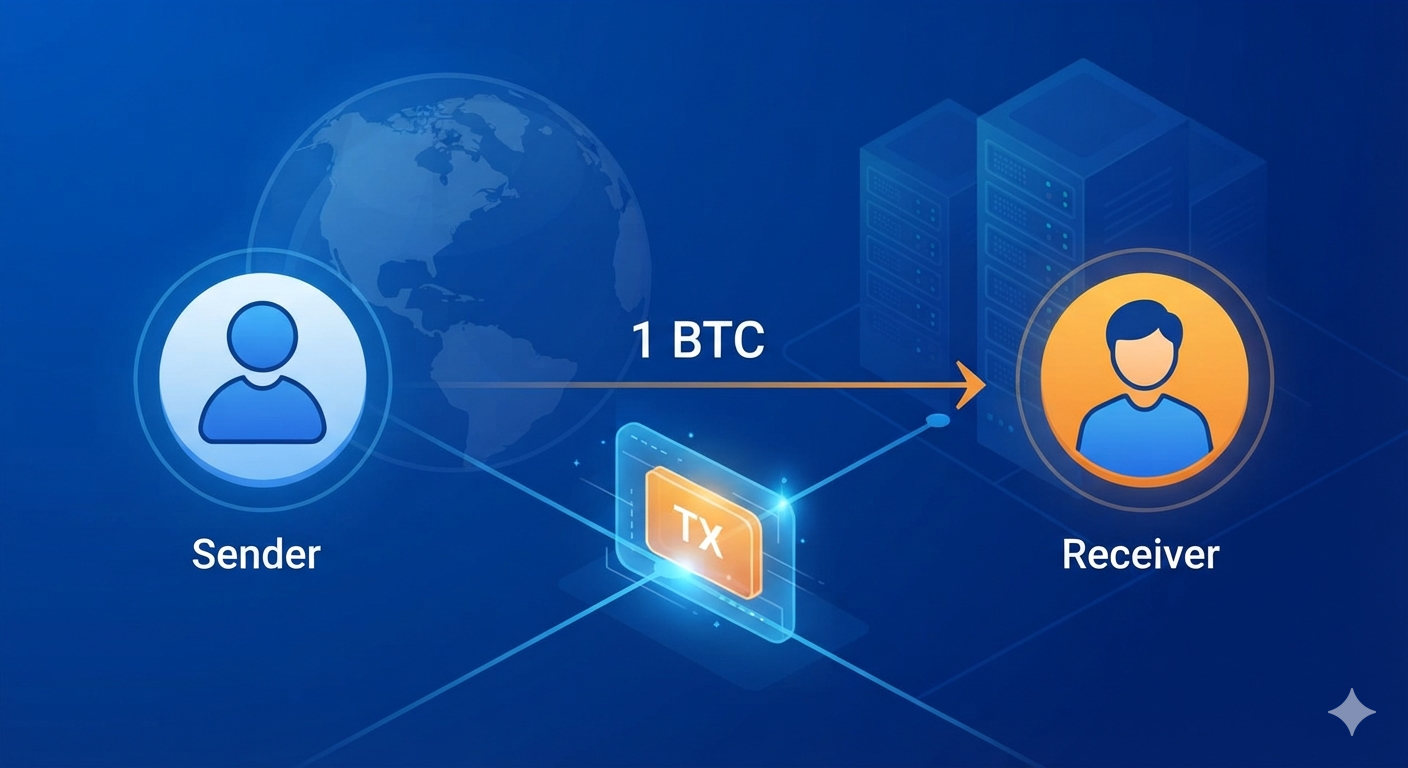
Alice sends digital assets to Bob.
The transaction contains information needed by the blockchain to process the transfer.
Step 2: The transaction is broadcast
The transaction is sent to the blockchain network.
Participating nodes receive the transaction and check whether it follows the network’s rules.
Step 3: The transaction is verified
The network checks things such as:
- Whether the transaction is properly formatted
- Whether the sender has the necessary authority
- Whether the transaction satisfies protocol rules
- Whether the same assets are being spent improperly
The exact checks depend on the blockchain.
Step 4: Valid transactions are grouped
Valid transactions can be grouped together into a block.
The process used to select and finalize blocks depends on the blockchain’s consensus mechanism.
Step 5: The network reaches consensus
Participants follow the blockchain’s rules to determine which block should be accepted.
Step 6: The block is added
Once accepted, the block becomes part of the blockchain.
Step 7: The transaction receives additional confirmation or finality
Depending on the blockchain, later blocks may provide additional confirmation, or the network may use another mechanism to establish finality.
This process allows a distributed network to maintain a shared history.
What Is Consensus in Blockchain?
Consensus means agreement.
A blockchain network needs a way for participants to agree on the valid state of the ledger.
Imagine thousands of computers receiving transactions at approximately the same time.
What happens if different computers see different transactions first?
The network needs rules for determining which transactions and blocks should be accepted.
This is where consensus mechanisms come in.
Consensus mechanisms are protocols that help blockchain participants agree on the state of the network.
Two widely discussed approaches are:
- Proof of Work
- Proof of Stake
Other consensus models also exist.
Proof of Work Explained
Proof of Work, or PoW, is the consensus mechanism used by Bitcoin.
In Proof of Work systems, miners compete to solve a computational puzzle associated with creating a valid block.
The process requires significant computational work.
A simplified version looks like this:
- Transactions are collected.
- A miner constructs a candidate block.
- The miner performs repeated calculations.
- The miner searches for a valid result according to the network’s rules.
- A valid block is broadcast.
- Other nodes verify it.
- If it follows the rules, the network accepts it.
Proof of Work helps protect the network because creating valid blocks requires resources.
However, Proof of Work can consume significant electricity and requires specialized hardware for competitive mining on major networks.
Proof of Stake Explained
Proof of Stake, or PoS, takes a different approach.
Instead of relying primarily on computational mining, Proof of Stake networks use participants who commit or stake cryptocurrency according to the protocol’s rules.
These participants can help validate transactions and blocks.
A simplified process may involve:
- Participants lock or commit assets according to network rules.
- The protocol selects validators through its consensus mechanism.
- Validators participate in proposing or checking blocks.
- Valid blocks are accepted.
- Participants may receive rewards for following the rules.
- Protocol penalties can apply to certain forms of misconduct.
The exact design differs significantly between Proof of Stake blockchains.
Proof of Work vs Proof of Stake
| Feature | Proof of Work | Proof of Stake |
|---|---|---|
| Main resource | Computing power | Staked assets |
| Common role | Miners | Validators |
| Energy requirements | Generally higher | Generally lower |
| Security model | Computational work | Economic stake and protocol rules |
| Example | Bitcoin | Ethereum |
| Hardware needs | Often specialized | Usually different infrastructure |
Neither term should be treated as describing every detail of a blockchain’s security. Real-world implementations are more complex.
Why Is Blockchain Transparent?
Transparency is one of the notable characteristics of many public blockchains.
On a public blockchain, users can often inspect transactions using a block explorer.
They may be able to see:
- Transaction amounts
- Transaction times
- Wallet or address information
- Block numbers
- Transaction IDs
- Confirmation status
However, transparency does not necessarily mean that users’ real-world identities are visible.
A blockchain address may not directly contain a person’s name.
For example, you might see:
Address A → Address B
without knowing who owns Address A or Address B.
This creates an important distinction between transaction transparency and personal identity transparency.
Is Blockchain Anonymous?
Blockchain is often described as anonymous, but this can be misleading.
Many public blockchains are better described as pseudonymous.
A user can interact through a blockchain address rather than directly using their name.
However, if an address becomes connected to a real-world identity, blockchain activity associated with that address may potentially be analyzed.
Blockchain analytics companies, exchanges, investigators, and researchers can use transaction patterns and other information to study public blockchain activity.
Therefore, users should not automatically assume that transactions on a public blockchain are completely private.
How Does Blockchain Security Work?
Blockchain security comes from several technologies and network mechanisms working together.
Important components can include:
- Cryptography
- Digital signatures
- Hash functions
- Distributed networks
- Consensus mechanisms
- Economic incentives
- Independent verification
- Private keys
Let’s examine these concepts.
Cryptography
Cryptography helps protect blockchain information and transactions.
It is used to create secure digital signatures, hashes, and other mechanisms that allow networks to verify data.
Digital Signatures
A digital signature can demonstrate that someone controlling the appropriate private key authorized a transaction.
This is particularly important in cryptocurrency systems.
Private Keys
A private key is secret information that can give someone control over blockchain assets associated with it.
If another person obtains the private key, they may be able to authorize transactions.
That is why private-key security is extremely important.
Distributed Verification
Multiple independent nodes can verify blockchain transactions and blocks.
This can make it more difficult for one compromised computer to silently rewrite the entire network.
Why Is Blockchain Difficult to Tamper With?
Blockchain security is based on more than simply putting information into blocks.
A network can combine:
- Cryptographic hashes
- Digital signatures
- Consensus rules
- Distributed nodes
- Economic incentives
- Network validation
Suppose someone tries to alter a historical transaction.
They may need to overcome multiple layers of protection.
On a large decentralized network, this can be extremely difficult and expensive, depending on the attack and blockchain design.
However, no blockchain is automatically immune to attacks.
Security depends on:
- Network size
- Consensus design
- Software quality
- Validator or miner distribution
- Economic incentives
- Private-key security
- Smart-contract security
- Governance
- User behavior
What Are Smart Contracts?
A smart contract is software deployed on a blockchain that executes according to programmed rules.
The term can sound complicated, but the basic concept is simple.
Imagine a vending machine.
You insert the required money, select a product, and the machine follows programmed instructions to provide the product.
A smart contract can work in a similar conceptual way.
If certain blockchain conditions are satisfied, the program performs predefined actions.
Smart contracts can support:
- Decentralized exchanges
- Lending applications
- Digital collectibles
- Token systems
- Games
- Financial applications
- Automated payments
- Decentralized organizations
However, smart contracts are software and can contain bugs or security vulnerabilities.
Blockchain and Cryptocurrency
Blockchain and cryptocurrency are closely connected, but they are not exactly the same thing.
Cryptocurrency is a type of digital asset.
Blockchain is one technology used to record and manage transactions involving many cryptocurrencies.
Bitcoin uses the Bitcoin blockchain.
Ethereum uses the Ethereum blockchain and supports its native asset, Ether, along with many other tokens and applications.
There are also blockchain networks designed for purposes beyond cryptocurrency.
Therefore:
Blockchain ≠ cryptocurrency
Cryptocurrency is one major use case of blockchain technology, but blockchain has a broader range of applications.
Real-World Applications of Blockchain
Blockchain technology is being explored and used across different industries.
Let’s look at some major examples.
1. Financial Services
Financial institutions can explore blockchain for:
- Payments
- Settlement
- Asset transfers
- Tokenized assets
- Cross-border transactions
- Record keeping
Blockchain can potentially reduce the number of separate databases that different organizations need to reconcile.
However, regulatory requirements, privacy, scalability, interoperability, and integration remain important considerations.
2. Supply Chain Management
Supply chains often involve multiple organizations.
A product may move through:
Manufacturer → Distributor → Warehouse → Retailer → Customer
Each participant may maintain separate records.
Blockchain can provide a shared record of selected supply-chain events.
Potential uses include tracking:
- Product movement
- Shipment information
- Certifications
- Origin records
- Inventory events
The usefulness depends heavily on whether the information entered into the blockchain is accurate.
Blockchain can protect the integrity of recorded information, but it cannot automatically guarantee that the original information was truthful.
This is sometimes described as the “garbage in, garbage out” problem.
3. Healthcare
Healthcare organizations manage sensitive information and require strong privacy protections.
Blockchain technology has been explored for:
- Medical record coordination
- Credential verification
- Data sharing
- Supply-chain tracking
- Research records
However, healthcare applications require careful handling of privacy, regulations, access controls, and data storage.
A blockchain is not automatically the right place to store complete medical records.
Some designs may store references or proofs on-chain while keeping sensitive information elsewhere.
4. Digital Identity
Blockchain technology can also be used in digital identity systems.
A blockchain-based identity system could potentially help people manage credentials or prove specific information without repeatedly depending on centralized databases.
Potential applications include:
- Professional credentials
- Educational certificates
- Digital identification
- Verification systems
The exact privacy and security properties depend on the system’s design.
5. Voting and Elections
Blockchain is sometimes proposed for digital voting.
The idea is that blockchain could create an auditable record of votes.
However, secure electronic voting involves much more than creating an immutable database.
Important challenges include:
- Voter authentication
- Ballot secrecy
- Device security
- Coercion resistance
- Accessibility
- Election administration
- Privacy
- Auditing
Therefore, blockchain by itself does not solve every problem associated with electronic voting.
6. Real Estate
Property transactions involve ownership records, contracts, payments, and government records.
Blockchain applications could potentially support:
- Property records
- Tokenized ownership
- Transaction histories
- Digital agreements
- Automated processes
However, real estate ownership ultimately depends on legal systems and recognized authorities.
A blockchain record alone does not necessarily create legal ownership.
7. Digital Art and NFTs
Blockchain technology made it possible to create widely accessible systems for recording ownership or transaction histories of digital tokens.
These tokens are often called NFTs, or non-fungible tokens.
An NFT is a unique blockchain-based token representing a particular digital or physical-linked asset under a specific system.
NFTs have been used for:
- Digital art
- Collectibles
- Gaming items
- Memberships
- Event access
- Digital certificates
An NFT does not automatically mean that the buyer owns copyright or all intellectual-property rights associated with an underlying image or work.
The rights depend on the relevant terms and legal arrangements.
8. Gaming
Blockchain technology has also been introduced into gaming.
Possible applications include:
- Digital items
- In-game assets
- Player-owned tokens
- Marketplaces
- Collectibles
- Cross-platform asset concepts
However, blockchain gaming remains a developing area, and the usefulness of blockchain depends on the individual game’s design.
9. Intellectual Property and Royalties
Blockchain can potentially provide records of ownership, licensing, and payment events.
Creators may explore blockchain systems for:
- Digital rights management
- Royalty tracking
- Licensing
- Content ownership records
Again, blockchain records do not automatically determine legal copyright ownership.
Legal agreements and applicable laws remain important.
10. Carbon Credits and Environmental Tracking
Blockchain has also been explored for environmental markets.
Possible uses include recording:
- Carbon credits
- Renewable-energy certificates
- Environmental claims
- Supply-chain sustainability information
The challenge is ensuring that the underlying environmental information is accurate.
Blockchain can help maintain records, but it cannot independently verify physical-world events without reliable data sources.
What Are the Advantages of Blockchain?
Blockchain technology can provide several potential advantages.
Decentralization
Some blockchain networks distribute control and record keeping across many participants.
This can reduce reliance on a single central database.
Transparency
Public blockchains can allow participants to independently inspect transaction records.
Auditability
Blockchain records can create a chronological history that is useful for auditing.
Tamper Evidence
Cryptographic linking and consensus mechanisms can make unauthorized changes detectable or difficult.
Global Accessibility
Public blockchain networks can often be accessed from anywhere with an internet connection.
Programmability
Smart contracts allow blockchain systems to execute programmed logic.
Reduced Reconciliation
When multiple organizations share a common ledger, some forms of record reconciliation may become simpler.
What Are the Disadvantages of Blockchain?
Blockchain also has important limitations.
Scalability
Some blockchains cannot process transactions as quickly as centralized systems.
Transaction Costs
Fees can increase when network demand is high.
Energy Consumption
Proof of Work networks can consume significant energy.
Complexity
Blockchain systems can be difficult for beginners to understand and use safely.
Irreversible Transactions
Some blockchain transactions cannot easily be reversed once confirmed.
Private-Key Risk
Losing access to a private key can result in losing control over associated assets.
Smart Contract Bugs
Poorly written smart contracts can contain vulnerabilities.
Privacy Challenges
Public blockchains can expose transaction histories that may be analyzed.
Regulation
Blockchain and digital assets are subject to different legal and regulatory requirements across jurisdictions.
Is Blockchain Completely Secure?
No technology is completely secure.
Blockchain can provide strong security properties, but the overall security of a blockchain-based system depends on many factors.
For example, a blockchain itself may function correctly while a cryptocurrency exchange, wallet application, bridge, or smart contract connected to it has a security vulnerability.
This is an important distinction.
A secure blockchain does not automatically mean that every application built on top of it is secure.
Users should therefore consider the security of the entire system.
Blockchain Security vs Wallet Security
Consider a cryptocurrency stored through a wallet.
The blockchain records ownership according to its rules.
But the user needs the appropriate private key or signing mechanism to authorize transactions.
If an attacker gains access to that key, the blockchain may correctly process the attacker’s transaction.
From the blockchain’s perspective, the transaction may look valid.
This is why users should protect:
- Private keys
- Seed phrases
- Passwords
- Recovery information
- Hardware wallets
- Devices
- Authentication accounts
Blockchain security and user security are closely connected, but they are not identical.
What Is Decentralization?
Decentralization means distributing control or decision-making among multiple participants rather than placing it entirely in one central authority.
In blockchain systems, decentralization can involve:
- Node distribution
- Validator distribution
- Miner distribution
- Developer participation
- Governance
- Infrastructure
The degree of decentralization varies from one blockchain to another.
A blockchain should not automatically be called decentralized simply because it uses the word “blockchain.”
Users should examine who controls the network, who validates transactions, how upgrades happen, and how many independent participants exist.
Public vs Private Blockchains
Blockchain systems can be designed for different environments.
Public Blockchain
A public blockchain is generally open to broad participation.
Examples include major public networks used for cryptocurrency and decentralized applications.
Public blockchains commonly emphasize:
- Open participation
- Transparency
- Distributed verification
- Public auditability
Private Blockchain
A private blockchain can restrict participation to approved organizations or users.
Businesses may explore private or permissioned blockchain systems when they want shared records but still require controlled access.
Permissioned Blockchain
A permissioned blockchain restricts certain activities to approved participants.
For example, a group of companies could operate a shared network where only authorized organizations can validate transactions.
Blockchain and Web3
Blockchain technology is also closely associated with the concept of Web3.
Web3 is a broad term used for internet applications that incorporate technologies such as:
- Blockchains
- Cryptocurrencies
- Smart contracts
- Decentralized applications
- Digital tokens
The idea is that users may have greater control over digital assets and interactions rather than relying entirely on centralized platforms.
However, Web3 applications vary significantly, and many still rely on centralized infrastructure.
What Is a Decentralized Application?
A decentralized application, often called a dApp, is an application that uses blockchain networks or smart contracts for some of its functions.
Examples can include:
- Decentralized exchanges
- Lending platforms
- Blockchain games
- NFT marketplaces
- Token applications
A dApp may still use traditional servers, websites, databases, or centralized services.
Therefore, “decentralized” can describe only certain parts of an application rather than every component.
Blockchain Fees
Many blockchain networks charge transaction fees.
These fees can help compensate network participants and protect the network against spam.
The fee structure depends on the blockchain.
Fees may be affected by:
- Network demand
- Transaction complexity
- Block capacity
- Required computational resources
- Network-specific fee markets
During periods of heavy activity, users may experience higher fees or longer waiting times.
This is one reason blockchain scalability remains an important area of development.
What Is Blockchain Finality?
Finality refers to when a transaction is considered sufficiently confirmed or irreversible according to a blockchain’s rules.
Different blockchains achieve finality differently.
Some systems rely on additional blocks and probabilistic confirmation.
Others use explicit consensus mechanisms that provide stronger forms of finality.
For beginners, the key idea is:
A blockchain transaction may need to reach a certain level of confirmation before it is treated as final or highly unlikely to be reversed.
The exact meaning of finality depends on the blockchain.
Common Blockchain Myths
Myth 1: Blockchain and Bitcoin Are the Same Thing
They are not.
Bitcoin is a cryptocurrency and blockchain is the underlying distributed technology used by Bitcoin.
Myth 2: Blockchain Is Always Anonymous
Public blockchains can be transparent and pseudonymous rather than completely anonymous.
Myth 3: Blockchain Data Can Never Be Changed
Blockchain records are designed to resist unauthorized changes, but different networks have different governance and technical mechanisms.
Myth 4: Blockchain Is Always Better Than a Database
A traditional database can be a better choice for many applications.
Myth 5: Blockchain Automatically Makes Information Truthful
Blockchain can help protect recorded information from unauthorized alteration, but it cannot guarantee that information entered into the system was true.
Myth 6: Every Blockchain Is Decentralized
Blockchain designs vary significantly in their level of decentralization.
How Beginners Can Start Learning Blockchain
If you are completely new to blockchain, do not try to learn everything at once.
A simple learning path is:
Step 1: Learn Bitcoin
Understand:
- Bitcoin
- Transactions
- Wallets
- Mining
- Blocks
- Confirmations
Step 2: Learn Blockchain Basics
Study:
- Distributed ledgers
- Nodes
- Hashes
- Digital signatures
- Consensus
Step 3: Learn Ethereum and Smart Contracts
Understand:
- Smart contracts
- Tokens
- Gas fees
- dApps
Step 4: Learn Security
Learn how to protect:
- Private keys
- Seed phrases
- Passwords
- Devices
Step 5: Learn About Risks
Understand:
- Scams
- Phishing
- Fake applications
- Smart-contract vulnerabilities
- Market volatility
Step 6: Explore Real-World Applications
Look at blockchain use cases in:
- Finance
- Supply chains
- Identity
- Gaming
- Digital assets
- Business systems
Learning gradually is much more effective than trying to memorize every technical term at once.
Blockchain Glossary for Beginners
Blockchain
A digital ledger system where records are organized into linked blocks.
Block
A group of transactions or other data recorded together.
Node
A computer that participates in a blockchain network.
Distributed Ledger
A shared digital record maintained across multiple participants.
Consensus
The process used by network participants to agree on the state of the blockchain.
Proof of Work
A consensus mechanism based on computational work.
Proof of Stake
A consensus approach involving participants who stake assets according to network rules.
Hash
A cryptographic fingerprint generated from data.
Private Key
Secret cryptographic information used to authorize certain blockchain transactions.
Public Key
Cryptographic information associated with a private key and used in various verification processes.
Wallet
A tool that manages blockchain keys and allows users to interact with blockchain networks.
Smart Contract
Blockchain-based software that executes according to programmed rules.
Token
A digital asset created or represented on a blockchain.
Node
A computer participating in a blockchain network.
Block Explorer
A tool that allows users to inspect blockchain transactions and blocks.
dApp
An application that uses blockchain or smart contracts for some of its functions.
Finality
The point at which a transaction is considered final according to a blockchain’s rules.
Frequently Asked Questions About Blockchain
What is blockchain technology in simple words?
Blockchain is a way of recording information in connected blocks across a network of computers. Many blockchain systems allow participants to verify records without depending entirely on one central authority.
Why is blockchain called a chain?
Blocks are connected to one another using cryptographic references, creating a chronological chain of records.
Is blockchain only used for cryptocurrency?
No. Blockchain technology can also be explored for finance, supply chains, identity, digital assets, gaming, record keeping, and other applications.
What is a distributed ledger?
A distributed ledger is a digital record that can be maintained across multiple computers or organizations instead of relying on one central copy.
Why are blockchain transactions difficult to change?
Cryptographic links, digital signatures, distributed verification, and consensus mechanisms can make unauthorized changes difficult or detectable.
Is blockchain secure?
Blockchain networks can provide strong security properties, but no technology is completely risk-free. Wallets, smart contracts, exchanges, bridges, and other connected systems can have vulnerabilities.
What is consensus in blockchain?
Consensus is the process by which participants in a blockchain network agree on which transactions and blocks should be accepted.
What is the difference between blockchain and a database?
A traditional database is often controlled by one organization, while a blockchain can distribute records and verification across multiple participants. The best choice depends on the application.
Can blockchain records be deleted?
The answer depends on the blockchain and its architecture. Public blockchain records are generally designed to remain part of the historical ledger, although different systems have different mechanisms and governance models.
Does blockchain guarantee privacy?
No. Many public blockchains are transparent, meaning transaction information can be publicly inspected. Privacy depends on the blockchain and application design.
Can blockchain prevent fraud?
Blockchain can reduce certain forms of record manipulation and create auditable transaction histories, but it cannot eliminate all fraud.
What should beginners learn first?
Start with Bitcoin and basic concepts such as wallets, transactions, blocks, hashes, nodes, and consensus. Then move to smart contracts and decentralized applications.
Final Thoughts
Blockchain technology is essentially a new approach to digital record keeping.
Its most important ideas include distributed ledgers, blocks, cryptographic linking, consensus, transparency, and network-based verification.
Bitcoin demonstrated how blockchain could support a digital monetary network without relying on a traditional central bank or payment processor for every transaction. Since then, blockchain technology has expanded into areas such as decentralized finance, digital assets, supply-chain tracking, identity systems, gaming, and business applications.
At the same time, blockchain is not a solution to every problem.
It has limitations involving scalability, fees, privacy, energy use, regulation, user experience, and security. A blockchain can also be less efficient than a conventional database when decentralization and shared verification are not actually needed.
For beginners, the most useful approach is to understand the underlying concepts rather than focusing only on cryptocurrency prices or hype.
Once you understand how blocks, hashes, nodes, wallets, transactions, and consensus work together, the wider blockchain ecosystem becomes much easier to understand.
Blockchain is best viewed not simply as a cryptocurrency technology, but as a broader method for creating shared and verifiable digital records.